
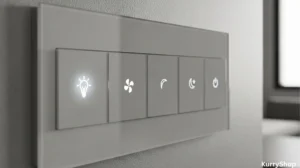
The first time I thought about smart switches wasn’t because I wanted a “smart home.” It was because I kept forgetting to turn the hallway light off before going to bed. Not in a dramatic way. Just that quiet, annoying moment when you’re already under the covers, phone charging, brain halfway asleep, and the light is still on. I tried ignoring it. I tried telling myself it didn’t matter. Eventually I got up, walked down the hall, turned it off, and thought, there has to be a less stupid way to handle this.
That’s usually how smart switches enter people’s lives. Not through some grand vision of automation, but through tiny frictions that repeat often enough to get under your skin.
At first, I assumed they were overkill. I’d seen smart bulbs. I’d seen voice assistants. I’d also seen plenty of half-broken setups in friends’ apartments where nothing worked quite right unless you spoke very carefully to a glowing cylinder on the counter. I didn’t want that. I just wanted the light to behave.
So I replaced one switch. Just one. And then, slowly, I forgot about it.
Which is kind of the point.
The upgrade you don’t notice (until it’s gone)
Smart switches are odd that way. They don’t draw attention to themselves. They don’t glow or beep or show you charts. They sit in the wall, doing exactly what a switch has always done. You can still walk by and flip it with your elbow when your hands are full. Guests don’t panic. Nothing feels “techy.”
But over time, small things start happening.
The light is already on when you walk into the room in the morning, because it learned roughly when that happens. The porch light turns off after sunrise without you thinking about it. You’re on vacation and don’t have that vague worry about whether you left something on, because you can check in two seconds and fix it if you did.
None of this feels dramatic. It just feels like the house is paying attention.
That’s what makes smart switches different from most gadgets. They don’t ask you to engage with them constantly. They quietly remove a layer of mental bookkeeping you didn’t realize you were doing.
Why switches, not bulbs?
This is usually the first question people ask once the idea clicks. Smart bulbs are cheaper. They’re easier to install. You just screw them in and connect them to an app. Why bother touching the wiring in your wall?
The answer has less to do with features and more to do with how people actually use lights.
A smart bulb stops being smart the moment someone turns the switch off. And someone always turns the switch off. You, your partner, your kids, a guest who doesn’t know the “rules.” Now the bulb is offline, the app can’t find it, and half the time you end up leaving the switch permanently on and controlling everything through your phone, which feels oddly backwards.
A smart switch flips the logic. The power is always there. The switch itself becomes the brain.
That means:
- Any bulb works. Cheap LED, fancy filament, whatever was already there.
- Physical control always works. No awkward “don’t touch that” conversations.
- Automations don’t break because someone used the wall like a normal person.
It’s a small architectural decision that ends up mattering every single day. On paper, smart switches come with a list of features. Wi-Fi. Zigbee. Thread. Schedules. Scenes. Voice control. Those words don’t mean much until you’ve lived with them for a while.
Wi-Fi switches feel convenient at first because they don’t require extra hardware. You connect them directly to your router. Setup is quick. But over time, especially in homes with lots of devices, they can feel slightly… chatty. If your Wi-Fi hiccups, a switch might lag or briefly go unresponsive. It’s rare, but noticeable when it happens.
Zigbee or Thread switches tend to fade into the background more. They talk through a hub, quietly, using very little power. The response when you tap the switch feels immediate in a way that’s hard to describe until you notice the absence of delay. Lights come on the moment your finger finishes the click, not half a beat later.
None of this matters in isolation. One light turning on a fraction of a second faster isn’t life-changing. But multiply that by every room, every day, and your house starts to feel less like a network and more like a place again.
That’s the technical nuance people don’t talk about enough. It’s not about specs. It’s about whether the system fades away or keeps reminding you it exists.
After a few months, the benefits stop feeling like “features” and start blending into routines.
Some of the things I ended up relying on surprised me:
- Lights that slowly ramp up in the morning instead of snapping on. Not enough to wake you violently, just enough to tell your brain it’s daytime.
- Bathroom lights that dim automatically at night so you’re not blasted awake during a 2 a.m. trip.
- A single tap by the front door that turns off everything except the bedroom lamp, because you always forget one room otherwise.
- Outdoor lights that follow the seasons without you ever adjusting a timer.
None of these are things you’d brag about. They’re barely things you’d remember to mention. But if you remove them, the house suddenly feels… slightly more annoying.
That’s when you realize the upgrade worked.
This is where smart switches earn their reputation for being “advanced.” You do have to open the wall. You do have to deal with wires. And you do need to know whether your home has a neutral wire, which older buildings sometimes don’t.
That said, most installations follow a predictable pattern. Power off. Remove the old switch. Match wires. Secure. Power back on. The first one takes time. The second is faster. By the third, you’re wondering why you ever thought it was intimidating.
There are a few practical things that make life easier:
- Label wires before disconnecting anything. Even if you think you’ll remember.
- Take a photo of the old setup. It’s a surprisingly effective safety net.
- Start with a non-critical room. Not the bathroom. Not the kitchen. Somewhere you can live with a mistake for an hour.
Once installed, though, they’re done. No batteries to change. No bulbs to pair. They just sit there, year after year, doing their job.
What most people get wrong about this
People assume smart switches are about control. About telling lights when to turn on and off more precisely.
They’re not. They’re about reducing decisions.
Every time you leave a room and pause to think, “Should I turn this off?” that’s a tiny cognitive load. Every time you wonder if you left something on, that’s another. Smart switches work best when they quietly answer those questions for you, without asking for attention in return.
The mistake is over-automating too early. Setting up complex rules before you’ve lived with the system. You end up fighting your own house, overriding things constantly, feeling like you’re being managed by software.
The better approach is boring. Live normally. Notice patterns. Add automations only where they mirror what you already do.
When people say smart homes feel annoying, it’s usually because they skipped that step.
If you’re trying to decide whether a particular smart switch makes sense, these are the things that actually matter day to day:
- Local control: Does the switch still work if the internet goes down?
- Response time: When you tap it, does the light react instantly or with a pause?
- Physical feel: Clicky, soft, flat, toggle. You’ll touch it more than any app.
- Neutral wire requirement: Not every home has one.
- Ecosystem compatibility: Apple Home, Google Home, Amazon Alexa — pick what you already use.
Specs like wattage limits and protocol versions matter, but mostly in edge cases. The list above is what you’ll notice every single day.
Apple vs Amazon (and why it’s not a war)
This comparison comes up constantly, and it’s usually framed like a rivalry. In practice, it’s more about temperament.
Apple’s HomeKit approach tends to feel restrained. Fewer compatible devices, stricter requirements, but a system that prioritizes privacy and consistency. When it works, it feels cohesive. When something goes wrong, there are fewer knobs to turn.
Amazon’s Alexa ecosystem is broader and looser. More devices, more brands, more experimentation. It’s easier to find a cheap switch that works, and easier to layer in voice control everywhere. The trade-off is that things can feel a bit noisier, a bit less unified.
Neither is objectively better. One feels like living in a well-designed apartment. The other feels like a busy, flexible workshop. Your tolerance for tinkering matters more than the logo.
One of the biggest misconceptions is that smart switches exist so you can talk to your lights. You can, of course. It’s occasionally useful when your hands are full or you’re already in bed.
But the real value is that you don’t have to.
The switch is still there. The muscle memory stays intact. You don’t feel silly talking to your walls. Voice control becomes an extra layer, not the primary interface.
That’s why smart switches age better than many smart devices. They don’t force you into a new behavior. They quietly support the old ones.
When they don’t make sense
It’s worth saying this plainly: smart switches aren’t always the right choice.
If you rent and can’t modify wiring, they’re a hassle. If you move frequently, the cost and effort might not be worth it. If you enjoy fiddling with smart bulbs and scenes and colors, switches won’t scratch that itch.
They also don’t solve every lighting problem. Lamps plugged into outlets still need smart plugs. Accent lighting still benefits from smart bulbs. Switches are infrastructure, not decoration.
That’s not a weakness. It’s just clarity.
Months in, maybe a year, you stop thinking about the switches entirely. They become part of the house, not a project. That’s when the real value shows up.
Energy savings happen quietly. Not in dramatic drops, but in fewer lights left on overnight, fewer “oops” moments. Wear and tear on bulbs decreases. Your routines feel smoother, less interrupted.
And if you ever move somewhere without them, you notice immediately. You find yourself standing in dark rooms, walking back to turn things off, wondering why the house feels slightly less cooperative.
That’s usually when people say, “I didn’t realize how much I liked those.”
There’s a lot of pressure in tech to chase novelty. Screens. Dashboards. Constant updates. Smart switches go the opposite direction. They make something old behave a little better, then get out of the way.
They don’t change how your home looks. They don’t demand attention. They don’t ask you to learn a new habit.
They just remove a few small annoyances you’ve lived with for years.
And once those are gone, it’s hard to remember why you tolerated them in the first place.