
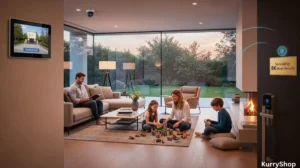
I checked a security camera because of a feeling rather than a noise, I felt a little silly. It was early evening, that in-between hour where the house is quiet but not sleepy yet. I was cooking, half paying attention, when I realized the front door hadn’t made its usual sound after the dog walker left. No slam, no latch click I could remember. Just a gap in my memory. So I wiped my hands, opened the app, and looked. The door had closed properly. Everything was fine. I didn’t feel relieved so much as… settled. The question mark disappeared. I went back to chopping onions.
That moment stuck with me because it had nothing to do with fear. I wasn’t worried about a break-in. I wasn’t imagining worst-case scenarios. I just wanted to know. And knowing let my brain move on.That’s what smart security actually does when it works well. It reduces uncertainty. Not danger, not risk in some dramatic sense, but the low-grade not-knowing that quietly eats at attention.
That’s what smart security actually does when it works well. It reduces uncertainty.
Not danger, not risk in some dramatic sense, but the low-grade not-knowing that quietly eats at attention.
That’s what smart security actually does when it works well. It reduces uncertainty.
Not danger, not risk in some dramatic sense, but the low-grade not-knowing that quietly eats at attention.
| The Old Way (Fear-Based) | The Smart Way (Awareness-Based) |
|---|---|
| Built around worst-case scenarios and constant threats | Built around understanding what’s actually happening |
| Loud alerts that interrupt you, even when nothing matters | Quiet, precise notifications that appear only when useful |
| Focused on reacting fast without enough context | Focused on clarity, leading to calmer decisions |
| Encourages frequent checking “just in case” | Lets you forget the system until it’s genuinely needed |
| Records everything, creating noise and overload | Captures what matters, making review fast and useful |
| Treats security as separate from daily life | Blends security naturally into everyday routines |
| Keeps danger top-of-mind, increasing anxiety | Reduces mental load by removing uncertainty |
| Feels like defending your home | Feels like simply understanding your home |
| Uses urgency and alarm-driven language | Relies on calm context and quiet confidence |
| Constantly noticeable | Invisible until it actually matters |
Fear gets all the marketing. Awareness does the real work.
If you listen to how home security is usually discussed, it sounds like everyone is living on the edge of disaster. Ads talk about intruders, alerts, protection, threats. The language is sharp and urgent. Real life isn’t like that most of the time. Most days, security is about confirming ordinary things. Did the garage door close? Was that noise a delivery or just someone walking past? Did the kids actually get home when they said they would?
Awareness isn’t exciting. It doesn’t spike adrenaline. It smooths things out. It takes small moments that could spiral into worry and resolves them quietly. When a system leans too hard into fear, it actually makes people less aware. Constant alerts, dramatic notifications, red warning banners — your brain learns to tune them out. They stop meaning anything specific. Awareness, by contrast, is precise. It gives you just enough information to make sense of what’s happening, and then it gets out of the way.
People worry about cameras making a home feel tense or invasive. That can happen, but it’s usually a sign of poor setup or bad design rather than the idea itself. A well-placed camera doesn’t feel like it’s watching you. It feels like it’s watching the edges of your space — the parts you can’t always see or hear. The difference matters.
A front door camera becomes background noise surprisingly fast. You stop thinking about it until you need it. When you do, you want it to load quickly, show you something recognizable, and then let you close the app. This is where technical features turn into emotional experiences. A higher resolution camera doesn’t impress you by being sharp. It impresses you by ending debates in your head. You don’t argue with yourself about what you’re seeing. You don’t zoom endlessly. You just know. Night vision isn’t about seeing everything in the dark. It’s about seeing enough to tell whether something matters. Grainy footage that technically “works” still leaves you unsure. Clarity equals calm.
The quiet satisfaction of things behaving predictably
There’s a strange comfort in systems that do the same thing every time. A door sensor that always triggers when it should, and never when it shouldn’t, fades into the background of your life. You stop thinking about it as technology and start thinking of it as a fact, like gravity. This predictability is what turns security from a gadget into infrastructure.
You arm the system without checking the screen. You disarm it while juggling groceries. It doesn’t ask questions or second-guess you. It just responds. The moment unpredictability creeps in — false alarms, delayed alerts, random disconnects — awareness turns back into anxiety. Not because something bad is happening, but because you can’t trust your tools anymore.
When people start thinking about smart security, they often want a definitive list. The problem is that specs don’t translate directly into lived experience. Still, there are a few things that consistently show up as quality-of-life improvements rather than bragging points:
- Motion detection that understands context
The difference between “motion detected” and “a person walked up to your door” is huge. One makes you curious. The other makes you stop what you’re doing. - Local processing or backup
You don’t notice this until the internet goes down. When the system keeps working anyway, it feels quietly competent. - Sensors that don’t overreact
Windows, doors, and motion sensors should be boring. Drama is a bug, not a feature. - Battery life that aligns with seasons, not weeks
Replacing batteries every few months feels manageable. Every few weeks feels like babysitting. - An app that opens where you expect
When you tap a notification, you want to see the moment that caused it, not a menu.
None of this sounds exciting, and that’s exactly why it matters. These are the things that make awareness effortless instead of demanding.
What most people get wrong about this…
The biggest misunderstanding is thinking security is about reacting fast. In reality, it’s about reducing the number of times you need to react at all. People imagine themselves jumping into action because of alerts. What actually happens is the opposite. Good systems lower your baseline stress so you’re not constantly scanning for problems.
Another mistake is assuming more data equals more safety. Recording everything, all the time, sounds thorough. In practice, it creates noise. Awareness depends on signal, not volume. There’s also an assumption that security should feel serious. That it should look imposing, sound loud, and announce itself constantly. But seriousness isn’t the same as effectiveness. The most effective setups are often the least noticeable. They blend into routines, respect boundaries, and only interrupt when interruption is genuinely useful.
Once you have reliable information about what’s happening around your home, your relationship with the space shifts. You stop wondering whether you forgot something. You stop replaying moments in your head, trying to remember if you locked a door or closed a window. That mental energy goes somewhere else. Into conversations. Into focus. Into rest. It’s subtle, but it’s real. The house starts to feel less like something you have to manage and more like something that supports you.
One of the hardest things for security platforms to get right is tone. A push notification is a tiny piece of language that can either reassure you or spike your heart rate. “Motion detected” is vague. “Person detected at front door” is specific. “Alert!” is unhelpful.
Over time, you learn which notifications deserve attention and which don’t. The system teaches you, too, by how often it interrupts you. The best setups feel like a friend tapping you on the shoulder when something’s worth noticing. Not shouting your name across the room every five minutes.
Apple vs Amazon, in everyday terms
Comparisons between ecosystems often get framed as battles. In practice, they’re more like different temperaments. Apple’s approach to smart security tends to emphasize restraint. Processing happens locally when possible. Privacy controls are prominent. The system feels like it would rather not bother you unless it’s sure. Living with Apple-centric security often feels calm and contained. Things happen quietly. There’s less customization, but also less temptation to over-tune everything.
Amazon’s ecosystem leans toward flexibility and reach. Integration is broad. Devices talk to each other easily. Features evolve quickly, sometimes messily. Using Amazon-based security can feel more active. More options, more integrations, more visibility into what’s happening. For some people, that translates into greater awareness. For others, it becomes noise. Neither philosophy is wrong. They just answer different questions. Do you want your system to do fewer things, very carefully? Or many things, very openly?
When awareness prevents overreaction
One unexpected benefit of smart security is how often it stops you from making a big deal out of nothing. A loud bang turns out to be a trash bin tipping over. A late-night alert shows a neighbor parking their car. A shadow crossing the yard is just a tree branch moving in the wind. Without that confirmation, your mind fills in the gaps. With it, the story ends quickly. This doesn’t make you complacent. It makes you proportionate.
There’s a subtle but important distinction between surveillance and awareness. Surveillance implies constant observation, often without purpose. Awareness is situational. It’s about understanding what’s relevant right now. Good security systems support awareness by making it easy to check, not by forcing you to monitor. You don’t sit there watching feeds all day. You glance when something feels off. You confirm. You move on. That’s a healthy relationship with technology.
When things break, and what that reveals
Every system fails eventually. Batteries die. Updates introduce quirks. Cameras lose connection during storms. How a security setup handles failure tells you a lot about its priorities. Does it tell you something’s offline, or does it stay silent? Does it recover gracefully, or require manual resets? Does it keep partial awareness, or go completely dark?
Systems built around awareness tend to degrade gently. You might lose video, but still get sensor alerts. You might miss a clip, but not an event. That layered approach matters more than perfect uptime.
Once you start thinking in terms of awareness, you notice how security overlaps with other parts of the smart home. Lights turning on when someone approaches aren’t just deterrents. They’re signals. Doors locking at night aren’t just protection. They’re closure. These small cues shape how you experience your home. They reduce friction. They create rhythms. Security stops being about danger and starts being about understanding.
Cameras and sensors exist in shared spaces, whether we acknowledge it or not. Neighbors, guests, delivery drivers — they all interact with your setup in small ways. Awareness includes being mindful of that. Angling cameras responsibly. Being transparent when appropriate. Using the tools to protect, not to pry. Most people navigate this without much trouble, but it’s part of the lived experience that rarely gets mentioned.
Why fear fades but awareness stays
Fear is exhausting. It can’t be sustained without burning people out. Awareness, on the other hand, integrates smoothly into daily life. Once fear fades, what remains is a quiet confidence. Not the kind that makes you feel invincible, but the kind that lets you stop worrying about what you can’t see.
You’re not bracing for something bad. You’re simply informed. And most days, that information tells you the same thing: everything’s normal. You glance at a feed, close an app, hear the familiar click of a lock engaging. Life continues, uninterrupted.