
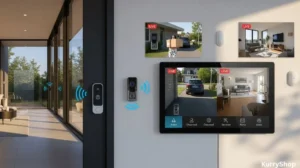
I realized how much I relied on home security, nothing dramatic was happening. I was half-asleep on the couch, late afternoon light slanting through the blinds, when my phone buzzed. Just a soft vibration. A delivery had been dropped off earlier than expected, and the camera caught it. No urgency, no adrenaline. I glanced at the clip, saw the box, and went back to whatever low-stakes show I had on. What stuck with me later wasn’t the footage. It was how little I’d thought about the system up to that moment. It had just been… there. Quiet. Doing its thing.
That’s the strange thing about smart home security. When it’s working, it fades into the background so completely that you forget it exists. And when you actually need it, you don’t want to be learning how it works for the first time.
Most days, smart security feels like infrastructure. Like plumbing or Wi-Fi. You don’t wake up thinking about it. You just expect it to be there, humming along quietly, catching the small stuff so you don’t have to. That invisibility isn’t accidental. The best systems are designed to reduce friction. No loud notifications for every passing car. No constant need to check dashboards or tweak settings. If you’re noticing your security setup all the time, it’s probably doing something wrong.
But invisibility doesn’t mean simplicity under the hood. It just means the complexity has been pushed out of your way. I didn’t fully appreciate that until a neighbor mentioned their camera system kept disconnecting whenever their router hiccupped. Suddenly, security became a chore. Reset this. Re-pair that. Check logs. It stopped feeling like protection and started feeling like maintenance. Good smart security avoids that feeling. It behaves more like a quiet presence than a gadget demanding attention.
What “smart” actually feels like, day to day
Marketing loves throwing specs around, but living with a system is different from reading about it. A camera with 4K resolution sounds impressive on paper. In practice, what you notice is whether you can tell the difference between a raccoon and a person at night without squinting. Higher resolution doesn’t feel like “wow, this is sharp.” It feels like confidence. You don’t second-guess what you’re seeing. You don’t zoom in and get a blurry mess. You just know.
The same goes for connectivity. Zigbee or Thread or plain old Wi-Fi aren’t things most people want to think about. What you notice instead is whether your door sensor still works when your internet drops, or whether automations fire instantly or after an awkward delay. Latency is one of those invisible factors that changes your perception. A light turning on half a second late makes the whole system feel dumb, even if it technically works. A notification that arrives while something is still happening feels reassuring. One that comes five minutes later just feels annoying. Smart security, at its best, blends into your routines. You arm the system without thinking. It disarms when you get home. It doesn’t ask for permission every time it does something helpful.
When people ask what to look for in a home security setup, I try not to turn it into a lecture. It’s more like the mental checklist you run through while standing in an aisle or scrolling reviews at midnight.
- Cameras that handle bad lighting gracefully
Not just night vision, but weird lighting. Headlights, porch lights, shadows from trees. If footage turns into a washed-out blur every time a car passes, you’ll stop trusting it. - Local processing, at least a little
This shows up as reliability. Motion detection that still works when the cloud is having a bad day. Clips that don’t vanish if a subscription lapses. - Sensors that don’t cry wolf
Door and window sensors should be boring. If you’re constantly dismissing alerts, your brain learns to ignore them. - Battery life that matches real life
“Up to six months” means very little. What matters is whether you’re changing batteries at inconvenient times or forgetting about them entirely. - An app that doesn’t feel like a control panel
You shouldn’t need a tutorial to check what’s happening at your own front door.
None of this is exciting on its own. That’s kind of the point. The excitement comes from not thinking about it.
Why smart security tends to disappear from your awareness
There’s a psychological side to this that doesn’t get talked about much. Humans are good at tuning out systems that behave predictably. It’s the same reason you stop noticing the hum of a fridge. Smart security earns invisibility by being consistent. Alerts mean something. Silence means nothing is wrong. Once that pattern sets in, your brain stops scanning for danger all the time.
When a system is noisy or unreliable, it keeps pulling your attention back. You’re never quite sure whether you should care. That low-level uncertainty is exhausting, even if nothing bad ever happens. The irony is that the better your security gets, the less you feel like you have security at all. It just feels like normal life continuing uninterrupted.
What most people get wrong about this stuff
Most people think home security is about catching something bad on camera. That’s only part of it, and often not the most important part. The real value is prevention and clarity. Visible cameras change behavior. Simple as that. They don’t have to look intimidating. They just have to be obvious enough to make someone think twice. That moment of hesitation is often all that’s needed.
Then there’s clarity. When something odd does happen, you don’t want drama. You want answers. Was that noise a person or just the wind? Did the door open or did the sensor glitch? Uncertainty is what turns small events into stress spirals.
Another common mistake is assuming more coverage equals better security. In reality, poorly placed devices create blind spots and false alerts. One well-positioned camera that actually captures faces is more useful than five that mostly record walls and sidewalks. People also overestimate how much they’ll want to “review footage.” In real life, you just want to know if everything’s fine. Digging through timelines feels like work, and nobody wants homework from their house.
Notifications are where smart security can either earn your trust or lose it fast. The best systems understand context. A notification at 3 a.m. feels different from one at 3 p.m. A person detected when you’re away matters more than when you’re home. Some platforms let you fine-tune this, but there’s a balance. Too many settings and you’ll never finish configuring them. Too few and you’re stuck with alerts that don’t match your reality.
What you want is a system that learns your rhythms without making you feel like you’re training it. Over time, alerts become rarer, and when they happen, you actually look. That’s a subtle achievement. It’s also why people who’ve lived with good security setups struggle to go back.
Apple vs. Amazon, without picking sides
Comparing Apple and Amazon in the smart home world is less about better or worse and more about philosophy. Apple leans hard into privacy and local control. HomeKit Secure Video processes footage on-device, which feels reassuring if you’re wary of cloud dependence. The downside is that hardware options can be limited, and setup sometimes assumes you’re already deep in Apple’s ecosystem.
Using Apple’s approach feels like everything is politely contained. It doesn’t shout. It doesn’t overshare. When it works well, it’s almost boring, in a good way. Amazon, on the other hand, emphasizes scale and integration. Ring and Alexa play nicely with a huge range of devices. Features roll out quickly. The ecosystem feels expansive, sometimes messy, but flexible.
Living with Amazon-based security can feel more dynamic. More options, more integrations, more data flowing around. For some people, that’s empowering. For others, it’s a bit much. Neither approach is inherently superior. One prioritizes restraint. The other prioritizes reach. What matters is which trade-offs you’re comfortable living with long-term.
One of the most underrated benefits of smart security is how quickly it resolves small anxieties. You hear a noise outside. Instead of lying there wondering, you check the camera. It’s a cat. Done. Your brain moves on. That sounds trivial, but those moments add up. Without clarity, your mind fills gaps with worst-case scenarios. With clarity, you get closure in seconds.
This is where good design really shows. Footage loads quickly. The clip starts at the right moment. You don’t scrub endlessly. You get what you need and you’re done. Over time, you stop reacting emotionally to every unfamiliar sound. You trust that if something matters, you’ll know.
When things do go wrong
No system is perfect. Batteries die. Wi-Fi drops. Updates introduce bugs. What matters is how gracefully failure is handled. Does the app tell you something’s offline, or do you find out when you need it most? Is there redundancy, or does one weak link break the whole chain?
Some setups include cellular backups or local storage that kicks in quietly. You don’t notice until later, when you realize footage is still there despite an outage. That’s the kind of resilience you don’t appreciate until after the fact. It doesn’t feel like a feature. It feels like things not falling apart.
The more integrated security becomes, the less it feels like a separate system. Lights turning on automatically when motion is detected outside. Doors locking themselves at night. Cameras that pause recording when you’re home, without being asked.
These little interactions blur the line between security and comfort. You’re not “arming a system.” You’re just living in your space. The danger is over-automation. When too much happens automatically, it can feel uncanny or frustrating. But when it’s tuned well, it fades into the background like everything else that works.
There’s also a quiet social shift that comes with visible security. Delivery drivers know where to leave packages. Neighbors recognize cameras and act a little more mindful. There’s an unspoken understanding that the space is cared for.
At the same time, there’s a responsibility not to let security turn into surveillance. Pointing cameras thoughtfully. Respecting boundaries. Being aware of what you’re recording and why. Most people navigate this intuitively, but it’s worth acknowledging. Security is about protection, not control.
Why it’s hard to explain the value until you’ve lived with it
If someone asks whether smart home security is “worth it,” the honest answer is unsatisfying. It depends on how much you value peace of mind, and how much you notice its absence. Before having it, you imagine dramatic scenarios. After having it, you mostly notice how ordinary everything feels. That ordinariness is the payoff.
You don’t wake up feeling safer. You just don’t feel unsafe. You don’t think about break-ins. You think about coffee, work, weather. The system is there, quietly narrowing the gap between uncertainty and knowledge.
And when something unusual does happen, you’re not scrambling. You already have context. You already know where to look. That’s when the invisibility lifts for a moment. Just long enough to remind you why you put it there in the first place.