
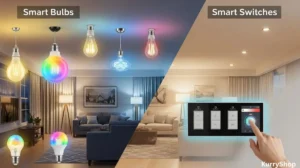
I thought seriously about lighting wasn’t because I wanted a “smart home.” It was because I was half-asleep, standing in the hallway at 2 a.m., flipping a switch that didn’t do anything. The bulb was smart. The switch was dumb. And my brain, at that moment, was even dumber.
That tiny frustration is what pushed me down the rabbit hole of smart bulbs versus smart switches. Not the ads. Not the future-of-living promises. Just the basic question: when you’re tired, distracted, or rushing out the door, which one actually makes life easier? Because on paper, both sound great. In real houses, with real people, they behave very differently.
It really comes down to a simple moment. You’re tired, half-awake, maybe running late, and you just want the light to do what you expect. That’s where the difference shows up. On paper, smart bulbs and smart switches both sound solid. In actual homes, with real people touching the wall, they end up behaving very differently.
| Feature | Smart Bulbs | Smart Switches |
|---|---|---|
| Installation effort | Very easy — just replace the bulb | Moderate — requires wiring and switch replacement |
| Works if the wall switch is off | ❌ No — the bulb loses power | ✅ Yes — the system stays active |
| Colors & mood lighting | ✅ Excellent — colors, scenes, smooth dimming | ❌ Limited — mostly standard dimming |
| Daily reliability | ⚠️ Medium — depends on Wi-Fi and user behavior | ✅ High — very stable in daily use |
| Guest & kid friendly | ❌ Low — wall switches confuse people | ✅ High — works like a normal switch |
| Long-term cost | Higher — cost adds up per bulb | Lower — one switch controls multiple bulbs |
| How it feels after months | Fun at first, sometimes annoying later | Quietly reliable — you forget it’s smart |
What lighting feels like before it gets “smart”
Most homes already have a rhythm when it comes to lights. You don’t think about it much. You walk into a room, your hand goes to a familiar spot on the wall, click, light. Your body knows where that switch is even in the dark. That muscle memory is important, and it turns out it’s the first thing smart lighting likes to mess with.
Smart bulbs and smart switches both promise convenience, but they interrupt that rhythm in different ways. One changes the bulb you already have. The other replaces the control you’re used to touching every day. That difference sounds small until you live with it.
Smart bulbs: the appeal is obvious at first
Smart bulbs are usually the gateway drug. They’re cheap enough, easy to install, and feel kind of magical the first week. You screw one in. You download an app. Suddenly your lamp can turn blue, dim to 37%, or fade on slowly in the morning like a fake sunrise. That part genuinely feels cool.
What using them actually feels like day to day is more mixed. When people talk about features, they usually list things like:
- Millions of colors
- App control from anywhere
- Voice commands through Alexa or Google Assistant
- Scheduling and automation
- Zigbee, Bluetooth, or Wi-Fi connectivity
But living with those features isn’t the same as reading about them. Color-changing, for instance, is fun in bursts. You’ll set a warm orange glow once, feel proud of yourself, then forget it exists for weeks. The real value ends up being softer whites at night and brighter light in the morning. The rainbow stuff quietly fades into the background.
Voice control sounds futuristic until you realize how often you don’t want to talk. Saying “turn on the living room lamp” is fine when you’re alone. Less so when you have guests, kids, or someone asleep on the couch. And then there’s the big one: power. If someone turns off the wall switch, the smart bulb becomes… a regular, very confused bulb. No app control. No schedules. Just darkness until the switch goes back on. This is where smart bulbs start to argue with real life.
People turn off switches. They always will. Guests don’t know your setup. Kids don’t care. You yourself will flip a switch out of habit, even after months. It happens when you’re distracted, tired, or just moving too fast. Once that switch is off, the bulb disappears from your smart home universe. Your app still thinks it’s there. Your automation still tries to talk to it. Nothing happens.
You’ll notice this especially with routines. You set lights to turn on at sunset. One night, half the room stays dark because someone manually killed the power earlier. Now you’re standing there wondering if your automation broke or if you’re losing your mind. This doesn’t make smart bulbs bad. It just means they work best in places where the switch is rarely touched. Lamps plugged into outlets are perfect. Accent lights. Bedside lamps. Anywhere the bulb is the only real control point. Ceiling lights in shared spaces? That’s where friction starts.
Smart switches: boring on the surface, calmer in real life
Smart switches don’t feel exciting. No colors. No flashy app screens. Most of the time they look exactly like the switch they replaced. That’s their strength. When you install a smart switch, you’re making the wall control smart instead of the bulb. Power stays consistent. The switch always works. The light turns on whether the internet is down or your phone battery is dead. Using one feels… normal. And that’s a compliment.
You walk in. You flip the switch. The light comes on. If you want to control it remotely, schedule it, or use voice commands, that layer sits on top instead of replacing your habits. Technically, smart switches usually offer things like:
- Physical on/off control that never stops working
- App and voice control layered on top
- Schedules that don’t break when power is cut
- Often better reliability with Zigbee or Z-Wave hubs
What that means in daily life is fewer “why didn’t this turn on?” moments. There’s also something quietly reassuring about muscle memory still working. Guests don’t need instructions. Kids can’t accidentally break your setup by flicking a switch. The downside is flexibility. If you want color control or per-bulb customization, switches can’t help. Every bulb on that circuit does the same thing, always.
Smart bulbs take about 30 seconds to install. That’s part of why they’re so popular. Smart switches are a different story.
You need to remove the old switch, deal with wiring, and sometimes discover things about your house you didn’t want to know. Older homes may not have a neutral wire, which many smart switches require. Suddenly your simple upgrade turns into a research project. Once installed, though, you rarely think about it again. There’s a quiet trade-off here:
- Smart bulbs are easy to start with, harder to live with perfectly
- Smart switches are harder to start with, easier to forget about
Which one is better depends a lot on how much friction you’re willing to accept upfront versus over time.
How reliability actually feels, not how it’s marketed
Manufacturers love to talk about protocols. Zigbee. Thread. Wi-Fi. Bluetooth. All of it sounds impressive. In daily use, reliability comes down to one question: does the light turn on when you expect it to?
Wi-Fi smart bulbs are convenient because they don’t need a hub. But they rely heavily on your router. If your network hiccups, lights can lag or fail silently. You tap the app, wait a second, tap again, then the light turns on twice as bright because both commands finally went through.
Zigbee-based bulbs and switches tend to feel steadier, especially when paired with a good hub. Commands feel more immediate. Schedules are more consistent. But you’re adding another device to manage.
Smart switches often feel more reliable simply because the physical switch is always there. Even if the “smart” part acts up, the light still works. That peace of mind is hard to measure until you lose it.
What most people get wrong about this whole debate
A lot of people frame this as a feature comparison. Colors versus no colors. Bulbs versus switches. Apps versus hardware. That misses the real question, which is control. Smart bulbs put control in software first. Smart switches keep control physical and layer software on top. Neither approach is objectively better. They just assume different things about how humans behave.
If you live alone, love tinkering, and enjoy fine-tuning scenes, smart bulbs can feel expressive and fun. If you live with other people, value predictability, or just want lights to behave like lights, smart switches feel calmer. Another mistake is assuming you must choose one or the other everywhere. Real homes rarely benefit from being purists. In practice, the setups that feel best usually mix both.
Smart switches for main overhead lights.
Smart bulbs for lamps, accent lighting, and personal spaces.
That combination respects how people move through a house. It lets shared spaces stay intuitive while allowing more control where it actually gets used. You stop fighting your own habits. And that, more than any feature list, is what makes smart lighting feel smart instead of fussy.
Upfront costs can be misleading. Smart bulbs seem cheaper until you realize you need one for every socket. Smart switches cost more per unit but control multiple bulbs at once. Over time, replacing a burned-out smart bulb costs more than replacing a standard bulb behind a smart switch. None of this is dramatic, but it adds up quietly. Especially in larger homes.
The Apple vs Amazon kind of comparison
This debate feels a bit like Apple versus Amazon devices. Smart bulbs are like voice assistants that want to be the center of attention. They shine when you engage with them intentionally. Smart switches are like background services. They work best when you barely notice them. Some people love tinkering. Others just want things to function. Most people are a mix, depending on the room and the day.
Where annoyance actually creeps in
Annoyance rarely comes from bugs. It comes from small mismatches between expectation and reality. Lights not turning on because someone flipped a switch earlier.
Apps that take just long enough to load to feel irritating.
Voice commands misunderstood at the worst moment. These aren’t deal-breakers. They’re paper cuts. Smart switches avoid many of those cuts simply by staying out of the way. Smart bulbs add more possibilities, and with them, more chances for friction.
After a while, you stop thinking about which technology is “better.” You just notice whether your house feels cooperative or stubborn. When lighting fades into the background, that’s success. When you’re troubleshooting instead of living, something’s off. The best setup isn’t the smartest one on paper. It’s the one that lets you forget about it most days, then quietly works the few times you actually need it to do something clever. And honestly, at 2 a.m., standing in a dark hallway, that’s all you really want.