
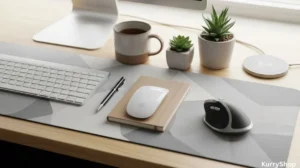
If you’re setting up a functional home office without overbuying, it’s easy to get caught up in gadgets that look good rather than tools that actually help. I didn’t set out to collect office gadgets. Most of them showed up slowly, one at a time, because something small kept annoying me. A stiff neck at the end of the day. Papers piling up where my coffee mug needed to go. That quiet frustration when a cable disappears behind the desk and somehow never comes back out.
None of these problems felt important enough to solve in a dramatic way. But they repeated. Daily. And eventually, a few simple tools earned a permanent place on my desk not because they were impressive, but because I reached for them without thinking.
There’s a quiet difference between gadgets you buy because they look good on a desk, and the ones that quietly keep your day from falling apart. Some tools photograph well. They sit there, clean and minimal, doing very little beyond existing. Others don’t look like much at all, but the moment they disappear, you feel it immediately. Your shoulders tense. Your eyes start burning earlier than usual. Small delays pile up. If a gadget going missing would make tomorrow harder, not just less pretty, that’s usually the one that matters. Those are the gadgets that matter. The ones you don’t admire. You just use them.
The tools that disappear into your routine
The mouse you stop noticing (and why that matters)
A bad mouse announces itself constantly. Your hand feels cramped. The clicks feel sharp. The pointer jumps when you don’t want it to. You might not complain out loud, but your body notices. A good mouse does the opposite. It disappears. Ergonomic mice get marketed like medical devices, which makes them easy to ignore. But comfort is cumulative. Small tension, repeated for hours, adds up by Friday.
What makes a mouse usable every day isn’t the number of buttons. It’s shape, resistance, and how little effort it takes to move. When your hand doesn’t have to adjust or compensate, you stop thinking about it. That’s the real upgrade. Wireless helps, not because wires are bad, but because they reduce friction. One less thing to bump into. One less thing to manage.
Keyboards you don’t brag about
People love to talk about keyboards. Mechanical switches. Sounds. Layouts. But most of that fades once the novelty wears off. What stays is how your fingers feel after typing thousands of words. Low-profile keyboards with decent travel tend to win in the long run. Not flashy. Not loud. Just predictable. The keys return when you expect them to. The spacing doesn’t make you think.
Backlighting isn’t about aesthetics. It’s about late afternoons when the light shifts and your eyes get tired. Being able to see without leaning forward matters more than it sounds. A keyboard you use every day isn’t one you admire. It’s one you never need to replace because nothing about it bothers you enough to justify the effort.
The things you feel more than you see
Most desks rely on overhead lighting that was never designed for close, focused work. It’s either too harsh or too weak, depending on the time of day. A good monitor light bar doesn’t announce itself. It just sits there, doing one specific job well. Unlike a desk lamp that throws light everywhere, it aims only at the surface you’re working on. The difference shows up late in the day. Less glare on the screen. Fewer moments where you catch yourself blinking hard or leaning back to rest your eyes.
Wrist rests fall into the same category. They don’t feel important in the morning. It’s only after hours of small, repetitive movements that their absence becomes obvious. A solid one doesn’t force your hand into position. It simply gives your wrist somewhere neutral to land, instead of pressing against a sharp desk edge all week long. You don’t notice these things working. You notice when they’re missing.
Monitor arms: the quiet posture fix
Most desks are set up wrong by default. The screen is too low. The angle is off. You lean forward without realizing it. Monitor arms don’t feel essential until you use one. Then sitting at a fixed-height monitor feels strange. The benefit isn’t flexibility. It’s alignment.
When the screen floats where your eyes naturally land, your shoulders drop. Your neck relaxes. You stop adjusting your chair every hour. This isn’t about productivity hacks. It’s about reducing tiny discomforts that distract you just enough to matter.
The notebook that survives everything else
Digital tools handle most things now, but paper still does one job better than screens: catching thoughts before they disappear.
The notebook you use every day isn’t precious. It opens flat. It fits where you need it. You don’t worry about ruining it.
Good paper matters, but durability matters more. A notebook that survives being shoved into a bag, spilled on, and written in at odd angles becomes reliable. And reliability builds habit.
You don’t open it because it’s inspiring. You open it because it’s there.
The tools that protect your focus
Switching between devices used to break my concentration more than I realized. Reaching for another mouse. Reconnecting Bluetooth. Mentally resetting for no good reason. A multi-device mouse or keyboard removes that friction. One click, and you’re back where you left off. No pause. No mental restart. It sounds minor until you add it up over a long week.
The same logic applies to charging. A single small GaN charger that can handle a laptop, phone, and headphones changes how cluttered your space feels. Fewer cables. Less heat. One thing to remember instead of three. It’s not about speed. It’s about not thinking.
Cable management isn’t about looks
Messy cables don’t just look bad. They create friction. You unplug the wrong thing. You knock something loose. You hesitate before moving your laptop because reconnecting feels annoying. Simple cable clips, sleeves, or trays remove that hesitation. Suddenly, moving things feels reversible. Nothing is permanently tangled. This matters because desks change. Workflows shift. A setup that adapts without punishment gets used longer.
When the room starts doing the work for you
Noise-cancelling headphones aren’t about music. They’re about control. In a shared home, a loud street, or a busy afternoon, they build a small boundary you can step into. The kind that lets your brain relax because it doesn’t have to filter everything anymore. A simple desk mat does something similar, just visually. It defines where work happens. Pens stop sliding. The desk surface stays intact. Your hands land in the same place every time. That consistency matters more than it sounds.
One way to tell whether a gadget truly earns its place on a desk is to look past how it looks and focus on how often it quietly shows up during the day.
A quick way to tell what actually earns its place on a desk
| Gadget Type | Why It Gets Used Daily | What Happens Without It | Long-Term Value |
|---|---|---|---|
| Ergonomic Mouse / Keyboard | Reduces daily hand and wrist strain without effort | Fatigue builds quietly, discomfort shows up by week’s end | Protects comfort over thousands of hours |
| Monitor Arm / Laptop Stand | Keeps screen aligned with natural posture | Neck and shoulder tension increases gradually | Prevents long-term posture issues |
| Desk Lighting / Light Bar | Improves visibility without screen glare | Eye strain appears earlier in the day | Supports visual comfort over long sessions |
| Multi-Port / GaN Charger | One charger replaces multiple cables | Cable clutter and outlet juggling return | Simplifies daily power management |
| Noise-Cancelling Headphones | Creates focus in noisy environments | Mental fatigue from constant background noise | Preserves concentration and energy |
The tools that quietly hold the day together
The charger that earns its spot
Chargers are invisible until they fail. The one you use every day is fast enough, sturdy enough, and placed exactly where your hand expects it. Multi-port chargers replace clutter with predictability. You stop hunting for outlets. You stop unplugging one thing to charge another. It’s not about speed. It’s about not thinking.
Document stands and why necks complain less
Reading from a desk flat on the surface forces your neck into awkward angles. You don’t notice immediately. You notice later. A simple document stand lifts papers into your line of sight. Suddenly, referencing something doesn’t pull your posture forward. This feels minor. It isn’t. Small adjustments repeated all day shape how tired you feel by evening.
Headphones you forget you’re wearing
Office headphones don’t need booming bass or dramatic noise cancellation. They need comfort and consistency. Lightweight, neutral-sounding headphones fade into the background. Calls sound clear. Music doesn’t distract. You wear them longer because they don’t remind you they’re there. That’s the pattern with daily-use gadgets: comfort beats excitement.
The underrated value of a good chair mat
Chairs roll. Floors scratch. Movement becomes hesitant when you feel resistance. A chair mat restores fluid movement. You shift positions without standing up. You roll back without effort. This sounds trivial until you remove the friction and realize how often you were compensating before.
Desk organizers that don’t over-organize
Too much organization creates its own mess. Drawers filled with dividers you don’t use. Trays for items you don’t reach for. The organizers that work are minimal. A place for the things you touch daily. Nothing more. When organization reflects actual behavior, it sticks.
The stand your laptop deserves
Laptop stands solve two problems at once: screen height and airflow. Raising the laptop prevents neck strain. Better airflow keeps fans quieter. Both improve focus indirectly. The key is stability. A stand that wobbles creates tension. One that doesn’t becomes part of the desk.
Whiteboards that live within reach
Big whiteboards are intimidating. Small ones invite use. A small board near your desk catches temporary thoughts. Reminders that don’t belong in a task manager. Notes that expire by tomorrow. You erase without guilt. That makes you use it more.
Reliability beats clever features
Over time, I’ve learned that the most useful gadgets tend to be the least demanding. They don’t need an app update. They don’t rely on servers being online. Wired connections, stable wireless, and tools that work the same way every single day end up winning. Daily routines don’t need novelty. They need consistency.
Why daily-use gadgets don’t feel exciting
The gadgets you use every day rarely make for good photos. They don’t impress visitors. They don’t start conversations. They solve recurring problems quietly. That’s why people often underestimate them. They look boring. But boredom, in this context, is success. Exciting gadgets demand attention. Useful ones remove it.
Daily office tools shape how tired you feel at the end of the day. Not dramatically. Incrementally. Less strain. Fewer interruptions. Fewer micro-decisions. The result isn’t higher productivity. It’s lower exhaustion. You leave work with something left in the tank.
The gadgets that last share a few traits:
- They reduce friction.
- They don’t ask to be learned repeatedly.
- They stay out of the way.
They don’t promise transformation. They deliver relief.
At some point, you stop thinking of these things as gadgets. They’re just part of how the day flows. Your hand reaches where it expects something to be. Your body sits where it’s comfortable. Your tools respond without argument. You don’t notice them working. You notice when they’re gone.