
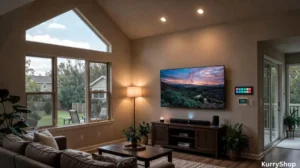
Living with home automation sounds clean and futuristic when you first hear about it. Lights that turn on by themselves. A thermostat that “learns” you. A house that quietly takes care of things in the background. On paper, it all feels obvious. Why wouldn’t you want that?
| Feature | The Dream (Marketing) | The Reality (Daily Life) | Helpful Score |
|---|---|---|---|
| Smart Lighting | Lights that perfectly adapt to your lifestyle | Hallway lights work great, living room sensors sometimes turn off too soon | 8/10 |
| Voice Assistants | Control your entire home with your voice | Helpful when it listens, annoying when it doesn’t | 6/10 |
| Smart Thermostat | A system that learns your habits automatically | Simple schedules feel more reliable than learning modes | 7/10 |
| Smart Plugs | Complete control over every device | Mostly used to turn off things you forget about | 8/10 |
| Home Routines | One tap runs the entire house | Too many routines become hard to remember | 5/10 |
| Smart Locks | Never worry about keys again | Convenient, but you still double-check the door | 7/10 |
| Security Cameras | Constant peace of mind | Too many alerts quickly lose meaning | 6/10 |
Then you actually live with it. That’s where the interesting part starts, because daily life has a way of sanding down big ideas into small, specific moments. Moments where you’re holding groceries and the lights don’t come on. Or where your heating schedule is technically correct but somehow still wrong. Or where you realize that the most useful automation in your house is not the one you were most excited about. This isn’t about what home automation can do. It’s about what it feels like when it’s woven into ordinary days.
One thing you notice early is that automation doesn’t spread its benefits evenly across your life. Some tasks become genuinely easier. Others become slightly more annoying in new ways. Lights are a good example. Motion sensors in hallways or staircases feel great almost immediately. You stop thinking about switches. Your hands are full, your brain is elsewhere, and the light just happens. There’s no learning curve there. Your body understands it before your brain does.
But put that same automation in a living room, and things get weird. You sit still reading, the lights go out. You wave an arm like you’re trying to get someone’s attention across the room. Suddenly you’re managing the system instead of forgetting it exists. What’s happening isn’t a technical failure. It’s a mismatch between how humans behave and how automation expects them to behave. We’re inconsistent. We pause. We zone out. We don’t move in predictable patterns, especially at home. Systems that work beautifully in transitional spaces often struggle in places where people linger. That’s a pattern you start to see everywhere.
When control feels better than intelligence
There’s a lot of marketing language around “smart” homes, but intelligence isn’t always what you want. Sometimes you just want something to respond, immediately and predictably. Voice assistants are a perfect case. When they work, they feel magical for about three seconds. You ask for a light, it turns on. Great. Then there’s background noise. Or a misheard command. Or the assistant answers a question you didn’t ask. Now you’re repeating yourself, adjusting your tone, simplifying your words like you’re talking to someone who’s half asleep.
At some point, many people quietly go back to buttons. Not because voice is bad, but because friction matters more than novelty. A physical switch doesn’t misunderstand you. It doesn’t need the internet. It doesn’t decide that now is a good time to explain the weather.
The irony is that the best home automation often reduces the need for intelligence. It relies on simple triggers, clear states, and obvious outcomes. When a system behaves like a dependable tool instead of a conversational partner, it blends in more easily. You stop thinking about it. And that’s usually the goal.
Setting schedules feels productive. There’s something satisfying about laying out your week in neat blocks of time. Lights at sunset. Heating in the morning. Devices off at night. For a while, it works. Especially if your routine is stable.
Then a small change happens. You work late. You wake up earlier. You stay home on a day you usually don’t. Suddenly the house is following a version of you that no longer exists. This is where automation can feel oddly impersonal. Not hostile, just out of sync. The heat comes on after you’ve already left. The lights fade when you’re still awake. Nothing is broken, but everything feels slightly off.
Some people respond by adding more rules. More conditions. If this, then that, unless something else. At a certain point, the system becomes so complex that only the person who built it understands it. Everyone else in the house just learns workarounds. Others simplify. Fewer schedules. More manual overrides. They accept that a home doesn’t need to be optimized every hour of the day. That flexibility, not precision, is what makes things feel human again.
Automation works best when it respects bad habits
There’s an idea that smart homes will make us more efficient, more disciplined, more aware. In reality, the most successful setups are the ones that quietly accommodate our laziness. Lights that turn off after you forget. Heating that drops when you leave without thinking about it. Plugs that cut power to devices you always swear you’ll unplug later.
These things work because they don’t ask you to change. They assume you won’t. You see this especially in energy-related automation. Very few people enjoy micromanaging consumption. They like saving money and wasting less, but they don’t want to track every decision. Systems that handle the boring parts automatically, without constant dashboards or alerts, tend to stick around. It’s not about making better choices. It’s about removing the need to choose in the first place.
One of the strangest realizations is that a “smart” home often gets better when you stop tweaking it. At the beginning, there’s a lot of experimentation. You adjust timings. You try new automations. You read forums. You chase edge cases. It’s engaging in the same way organizing a toolbox is engaging. Then, slowly, you get tired.
And that’s not a failure. It’s a signal. The systems that survive this phase are the ones that don’t require ongoing attention. They don’t send unnecessary notifications. They don’t break when an update rolls out. They don’t need you to explain them to guests. There’s a particular satisfaction in realizing you haven’t opened your automation app in weeks. Things are just happening. Or, more accurately, they’re not happening in ways that demand your involvement. Silence becomes a feature.
When things go wrong, they go wrong at the worst time
Manual systems fail too, but automation has a talent for failing at moments when you’re least patient. Internet goes down. Suddenly lights don’t respond. A cloud service has an outage, and a routine you didn’t even remember setting up stops working. You’re standing in the dark, thinking about how a basic switch never needed a status page.
This is why local control matters more than most people realize. Systems that keep working without the internet feel calmer, more trustworthy. Even if they’re less flashy, they fail more gracefully. It’s also why redundancy becomes comforting. A physical switch that still works. A manual thermostat option. An override that doesn’t involve logging into an account. You don’t think about these things when everything works. You really think about them when it doesn’t.
If you live alone, you can design your home around your preferences. If you don’t, automation becomes a social system as much as a technical one. Guests don’t want a tutorial. Neither do kids, partners, or anyone who just wants to turn on a light without triggering a scene.
The best setups respect intuition. Switches still behave like switches. Lights still turn on when you expect them to. Automation happens around the edges, smoothing things out rather than replacing familiar interactions. Homes that require explanation feel unfinished. Or worse, fragile. People become hesitant, unsure what they’re allowed to touch. That tension shows up quickly, and once it does, the tech starts to feel intrusive instead of helpful.
Security feels different when you live with it
Smart locks, cameras, sensors — they promise peace of mind. And sometimes they deliver it. Other times, they introduce a low-level anxiety you didn’t anticipate. Notifications are a big part of that. Too many alerts, and you stop trusting them. Too few, and you worry you’ll miss something important. Finding the balance takes time, and it’s rarely perfect.
There’s also the psychological shift of knowing your home is watching itself. Even if you trust the system, there’s a subtle change in how you relate to the space. For some people, it’s reassuring. For others, it feels like living inside a dashboard. The setups that feel healthiest tend to focus on clear events, not constant monitoring. A door opening when no one should be home. Movement in a space that’s usually empty. Specific signals that mean something, instead of a stream of digital noise.
Most discussions about home automation focus on compatibility, protocols, and platforms. Those things matter, but they’re not what most people struggle with. What’s harder is adjusting expectations. You start out imagining a house that anticipates your needs perfectly. What you end up with is a house that does a few things very well, a few things okay, and a few things in ways you eventually stop caring about. That gap can feel disappointing if you frame automation as a promise. It feels fine if you frame it as a tool.
The moment things click is often small. You notice you haven’t adjusted the thermostat manually in months. Or that you no longer worry about leaving lights on. Or that getting up at night is easier because the hallway gently lights up without waking you fully. These aren’t headline features. They’re background improvements. And they’re easy to miss if you’re waiting for something dramatic.
There’s a temptation to connect everything to everything else. Lights talk to speakers. Sensors trigger routines across the house. Data flows freely. Sometimes that’s useful. Often it’s just complexity. The systems that feel best over time usually have clear boundaries. Lighting handles lighting. Climate handles climate. Security stays focused on security. When they interact, it’s for a specific reason, not because it’s technically possible.
This reduces surprises. It also makes troubleshooting human-scale. When something goes wrong, you can usually guess where to look. Intentional separation sounds boring, but it creates a sense of stability. Your home feels less like a project and more like a place to live.
What actually sticks
After the novelty fades, a pattern emerges. Automation that saves effort without demanding attention tends to stay. Automation that asks for frequent adjustments slowly disappears. You disable it. You forget about it. You move on. What sticks is rarely the most advanced feature. It’s the one that quietly removes a small annoyance you used to tolerate every day.
The light you no longer think about. The door you no longer check twice. The heating that feels “about right” without explanation. Living with home automation isn’t about living in the future. It’s about reshaping the present in subtle ways. When it works, it doesn’t announce itself. It just gives you a little more mental space, and then gets out of the way.
He didn’t set out to build a smart home. That’s the part people usually get wrong. Mark just wanted his place to feel… easier. Not futuristic. Not impressive. Just easier in small, quiet ways. The hallway light was the first thing he changed. He used to come home late, half-thinking about tomorrow, half-thinking about nothing at all. Every night it was the same moment of fumbling for the switch, squinting, feeling slightly irritated for no good reason. Now the light comes on by itself. Soft, not blinding. It doesn’t ask anything from him. It just shows him the way to the kitchen. He didn’t tell anyone about it because there wasn’t much to tell.
The thermostat came later. He tried the “learning” mode for a while. It learned, sure. It also made some strange decisions. Mornings felt cold when they shouldn’t, afternoons warm when no one was home. Eventually he turned most of that off and set a simple schedule. Warm when he wakes up. Cooler at night. Nothing fancy. It’s not perfect, but it’s predictable, and that matters more than being clever. Sometimes friends ask if his house is smart. He usually shrugs. “It works.”
One evening his internet went down. He noticed because his phone did that thing where messages stop loading. He waited for the frustration to hit, the moment where everything breaks. It didn’t. The lights still worked. The door still locked. The heat stayed steady. He made dinner, washed a plate, sat on the couch. That’s when it hit him how little he actually wanted technology to be present in his life.
The best parts of the house were the parts he forgot about. The lights that turned off after he fell asleep. The outlet that cut power to the old space heater he always forgot to unplug. The small, silent corrections that happened without asking him to care. Once, a friend stayed over and asked how to turn on the bedroom light. Mark pointed to the switch. “Like normal.”
The automation was there, but it stayed out of the way. It didn’t explain itself. It didn’t try to be impressive. Late at night, when the house is quiet, the hallway light still comes on as he walks to get a glass of water. He never thinks about how it works. He just notices that he feels less tired than he used to. And that’s the thing no one puts on the box. A smart home isn’t about a house that thinks for you.
It’s about a house that lets you think a little less.