

The Day I Realized Lighting Wasn’t Just “Decor”
A few months ago, I stood in my bathroom at 6:30 a.m., squinting at my reflection under a harsh overhead light that made everything look slightly… unforgiving. Not dramatic. Just off. Shadows under my eyes were sharper than they should’ve been. The wall color looked colder. Even shaving felt harder because the light wasn’t landing evenly on my face.
I remember thinking: this room isn’t ugly. It’s just poorly lit. I work as an interior designer, mostly with homeowners who want their spaces to feel calmer and more intentional. We talk about layout, materials, finishes. But lighting — especially layered lighting — is where rooms either come alive or fall flat. And bathrooms, kitchens, entryways… they suffer the most when lighting is treated like an afterthought.
That morning pushed me to rethink not just my own bathroom, but how I approach fixture selection with clients. It wasn’t about brightness. It was about control.
The Mirror That Changed the Room
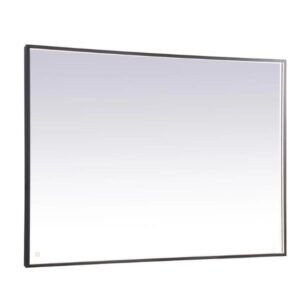
I replaced my basic vanity mirror with the Elegant Decor Pier LED Lighted Mirror (MRE64260BK). On paper, it sounds like a technical upgrade. In reality, it changed the way the entire room feels.
What makes it different isn’t just that it lights up. It’s how the light behaves. The glow is diffused behind an aluminum frame, so instead of blasting forward, it wraps gently around the edges. There’s something subtle about backlit illumination — it reduces the sharp shadow line you usually get under your chin or along your cheekbones.
The practical details matter too:
- Hardwired installation directly to a wall junction box
- Mountable vertically or horizontally
- Built-in touch sensor
- Three color temperature options: warm white, bright white, cool white
- Integrated dimmer
Those bullet points look technical, but what they really mean is flexibility. In the morning, I lean toward bright white — clearer, more neutral. At night, warm white feels softer, less clinical. Before, my bathroom light had one setting. Now it adapts to time of day and mood. That sounds small until you experience it. A mirror like this doesn’t scream for attention. It quietly fixes a problem you didn’t fully articulate.
Lighting Isn’t Just About Brightness
People often assume brighter is better. It’s not. Brightness without direction creates glare. Glare creates discomfort. Discomfort makes a space feel cold, even if the finishes are warm. Bathrooms especially benefit from layered light — something ambient, something task-focused, maybe even something decorative. When everything comes from one ceiling fixture, shadows become harsh and depth disappears.
The Pier mirror helped because it spreads light evenly across the face. No overhead-only spotlight effect. No strange undertones. I’ve used similar LED mirrors before, but many force you to choose one color temperature at purchase. That’s a commitment you don’t fully understand until you live with it. Having all three built in eliminates that guesswork.
What About Traditional Fixtures?
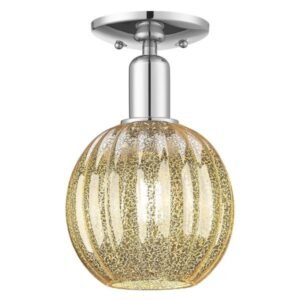
Not every room calls for modern backlit mirrors. Sometimes you want personality, or warmth, or texture. In a recent project, we installed the Bruno Marashlian Preston 7 Inch Semi Flush Mount (716-1C-PC-G458-7ME) in a hallway that felt flat and narrow. The fluted globe glass added depth without being ornate. The Arcadia frame kept it structured.
What stood out was the balance. The globe is curved and detailed; the frame is streamlined. That contrast creates visual tension, but in a quiet way. It’s technically a semi-flush mount, but visually it feels softer than many ceiling fixtures in that category. And because the glass diffuses light through subtle fluting, it avoids harsh downward beams.
When comparing something like this to a standard builder-grade flush mount, the difference isn’t just aesthetic. Builder fixtures often use thin glass and exposed bulbs that create hot spots. A fixture like Preston distributes light more evenly. Sometimes the difference between “fine” and “considered” is just that extra layer of design thinking.
Transitional Lighting Has Its Own Kind of Comfort
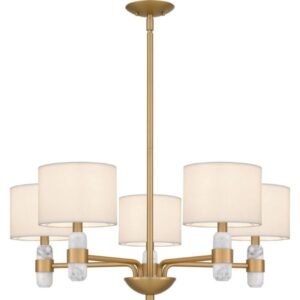
Not every client wants modern minimalism. Some homes lean traditional, but not in a heavy way. The Quoizel Kimberly 30 Inch Chandelier (KMB5030BWS) falls into that in-between space. It’s part of the Naturals collection, which incorporates materials like real white marble alongside brushed weathered brass and fabric shades.
What I appreciate about it is how those egg shell fabric shades soften the glow. Fabric diffuses light differently than glass. It feels warmer, almost like lamplight suspended in the air.
Here’s what makes it functional beyond style:
- Five-light configuration for balanced illumination
- Works over a kitchen table or breakfast nook
- Compatible with dimmers
- Mixed material construction (metal, marble, fabric)
Compared to a stark modern chandelier with exposed bulbs, Kimberly feels grounded. It doesn’t demand attention. It settles into the room. And marble accents, even small ones, add a tactile quality that photographs don’t fully capture.
When Drama Is the Point
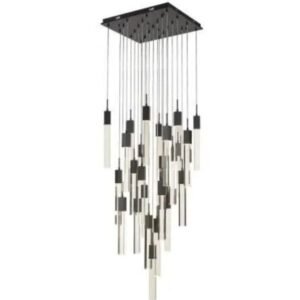
Then there are spaces where subtlety isn’t the goal. The Avenue Lighting Glacier Avenue 28 Inch 25 Light LED Multi Light Pendant (HF1904-25-GL-BK-C) is not quiet. It’s sculptural. Cascading LED points encased in clear crystals create vertical movement that draws your eye upward.
I installed one in a two-story entryway last year. During the day, it catches natural light. At night, it becomes the focal point. This is the kind of fixture that shifts a room’s identity.
Technical aspects worth noting:
- Integrated LED points
- Solid clear crystal encasements
- Multi-light suspension for layered sparkle
- Designed for dramatic vertical space
Compared to a standard chandelier, the Glacier Avenue feels more architectural. It’s less about symmetry and more about flow. It wouldn’t belong in every home. But in the right space, it transforms it.
Integrated LED: Practical or Limiting?
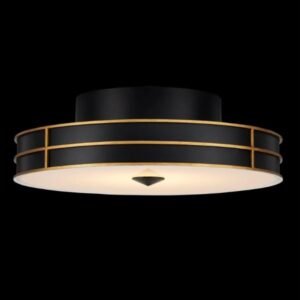
This question comes up often. Integrated LED fixtures — like the Currey and Company Fielding 24 Inch Flush Mount (9999-0071) — don’t use replaceable bulbs in the traditional sense. Some homeowners worry about longevity. But modern integrated LEDs are designed for long life spans, often tens of thousands of hours.
Fielding’s design leans Art Deco with a modern twist. Satin Black exterior, Contemporary Gold interior accents, Sugar White rim. There’s a hint of Hollywood glamour without going theatrical. Its profile is slim. That matters in lower-ceilinged spaces where drop length is limited.
Currey and Company Fielding 24 Inch
The integrated LED allows for a cleaner silhouette. No visible bulb bases. No uneven light distribution from mismatched bulbs. In older fixtures, you might swap bulbs every few years. With integrated LED, you’re investing in a longer-term solution — less maintenance, more consistency.
| Fixture Type | Best For | Lighting Effect | Style Impact |
|---|---|---|---|
| LED Lighted Mirror | Bathroom vanity & grooming | Even facial illumination, reduced shadows | Clean, modern, minimal |
| Semi Flush Mount | Hallways & bedrooms | Soft diffused overhead glow | Industrial or transitional |
| Chandelier | Dining areas & open kitchens | Layered ambient lighting | Decorative focal point |
| Multi-Light Pendant | High ceilings & entryways | Dramatic vertical illumination | Bold modern statement |
| Flush Mount (Integrated LED) | Low ceilings & compact rooms | Balanced ambient lighting | Sleek with subtle elegance |
Comparing Styles Without Forcing a Winner
It’s tempting to rank fixtures — modern versus transitional versus industrial — but lighting doesn’t work like that.
The Pier LED mirror solves a functional lighting issue in a bathroom.
The Preston semi-flush adds texture to a corridor.
The Kimberly chandelier softens a dining space.
The Glacier pendant creates drama in vertical rooms.
The Fielding flush mount blends Art Deco and modern efficiency.
Each serves a different purpose. Choosing between them isn’t about which is better. It’s about context. If you put a dramatic multi-light pendant in a small powder room, it overwhelms. Install a minimal flush mount in a grand foyer, and it disappears. Design decisions live in proportion.
Small Observations I’ve Learned the Hard Way
Warm light makes brass feel richer. Cool light makes marble feel sharper. Mirrors with edge lighting reduce makeup application errors because shadows are minimized. Fabric shades absorb a bit of brightness, which is comforting at night but might require higher wattage for task-heavy spaces.
Crystal fixtures reflect more than they emit — which means wall color and ceiling height influence their effect. These aren’t dramatic revelations. They’re things you notice after living with fixtures, not just installing them.
The Quiet Impact of Good Lighting
Lighting affects how we feel in a room more than most finishes do. You can repaint walls. You can change hardware. But if light is wrong, the space never quite settles. When I switched to the Pier LED mirror, mornings felt less harsh. When I dim the Kimberly chandelier during dinner, conversations feel slower, more relaxed.
Lighting doesn’t shout. It shapes. And once you start noticing it — the way shadows fall, the way warmth shifts with dimming — you can’t unsee it. I still think about that early morning in my bathroom, standing under unforgiving light. It wasn’t a design disaster. It was just a reminder that small details influence daily experience more than we admit. Now, when I flip a switch and the room responds the way it should, I don’t analyze it. I just notice that it feels right.