
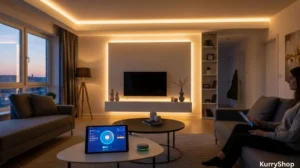
The first smart bulb I installed was in a hallway I barely used. That alone tells you something. I didn’t start with the living room or the bedroom. I started with a space where I was tired of flicking a switch while carrying groceries, only to realize the light was already on—or worse, still off behind me. It felt like a small annoyance, not a lifestyle problem. But it was enough to make me curious.
The first few days with smart lighting are always a bit theatrical. You turn lights on with your phone. You show other people. You say things like “watch this” and feel oddly proud. Then a week passes, the novelty fades, and that’s when the real question appears: does this actually change anything?
It turns out, some parts really do. Others quietly disappear into the background. And that difference matters more than most spec sheets suggest. People often judge smart lighting based on the first impressions. Voice commands. Color changes. Dimming from the couch. All of that is fun, but it’s not what sticks. What sticks is what you stop thinking about. After the first week, you’re no longer impressed that your lights respond to an app. You’re paying attention to whether they make evenings calmer, mornings smoother, or rooms feel more intentional without effort. That’s where the real value lives.
When automation stops feeling like control?
One of the first automations I set was painfully simple: hallway lights turn on at sunset and off at bedtime. No motion sensors. No fancy conditions. At first, I kept checking whether it worked. Then I forgot about it completely. That forgetting is important. It means the system isn’t asking for attention. It’s behaving the way you expect a home to behave.
Automation feels helpful when it mirrors habits instead of trying to replace them. Lights that turn on when you walk in can feel intrusive if they misfire. Lights that gently appear when you expect them feel natural, almost old-fashioned in the best way.
Smart lighting marketing loves colors. Millions of them, apparently. In daily life, color temperature matters far more. Cool white in the morning feels alert, sometimes too alert. Warm light in the evening makes rooms feel quieter, even if nothing else changes. What actually makes a difference is being able to shift this gradually, not dramatically.
A light that slowly warms over the evening feels like the house is winding down with you. You don’t notice it happening, but you notice the absence when it doesn’t. This isn’t about sleep optimization or productivity hacks. It’s about atmosphere that aligns with time.
Dimming gets framed as mood-setting. Candles. Dinners. Ambience. That’s not wrong, but it’s incomplete. The real benefit of dimming shows up on ordinary nights. When the overhead light feels too harsh, but turning it off leaves the room flat. When you want to keep the space usable without it feeling clinical. Smart dimming lets you land in the middle. You don’t have to choose between “on” and “off.” You choose “enough.” That small control reduces friction. It’s subtle, but it adds up.
Once you live with smart lighting for a while, you stop thinking in terms of features and start thinking in terms of behaviors. Things like:
- Lights turning off automatically when a room hasn’t been used
- Outdoor lights adjusting to seasons without manual changes
- Bedside lamps that don’t blind you during late-night wakeups
- Entryway lights that welcome you instead of surprising you
None of these require complex setups. They require thoughtful placement and restraint. The checklist isn’t about what the lights can do. It’s about what you want to stop doing yourself.
Connectivity: how it feels when it works (and when it doesn’t)?
People throw around terms like Wi-Fi, Zigbee, Thread, or Bluetooth as if they’re interchangeable. They’re not, but the difference only becomes obvious over time. Wi-Fi lights feel direct. They respond quickly, but they rely heavily on your network. When the internet stutters, so do they. That can be frustrating if your lighting becomes essential to daily routines.
Zigbee-based lights feel quieter. They communicate through a hub and form their own network. In practice, this means fewer random disconnects and less troubleshooting. You don’t notice them because they don’t demand attention. That lack of drama is the feature.
Bluetooth lighting often feels fine at first, then inconvenient. It works best when you’re nearby and actively using your phone. Over time, that limitation becomes noticeable. The technology matters less than the reliability. Lights that fail occasionally break trust, and once trust is broken, you start reaching for physical switches again.
One of the biggest mistakes people make is assuming smart lighting means abandoning switches. That’s rarely true. Guests don’t want instructions. Neither do tired people. Physical switches provide reassurance. The best setups respect that. Switches still work. Apps exist in the background. Voice control is optional. Smart lighting should layer on top of familiar habits, not replace them.
What most people get wrong about this…?
Many people believe smart lighting is about control. Being able to adjust everything precisely, anytime. In reality, the setups that last are the ones that reduce decision-making. If you’re constantly tweaking scenes, adjusting brightness, or fixing automations, the system is working against you. Good lighting decisions are made once, then trusted.
Another common misunderstanding is thinking more lights equal better lighting. Often, fewer well-placed lights with flexible behavior create better spaces than rooms filled with bulbs all doing different things. Smart lighting rewards simplicity.
When people choose smart lighting, they often start by choosing an ecosystem. Apple’s approach feels curated. Integration is tight, setup is relatively clean, and privacy is emphasized. It works best if you already live in that environment and value consistency over customization.
Amazon’s ecosystem is broad. There’s flexibility, a wide range of devices, and lots of compatibility. It’s friendly to experimentation but can feel cluttered if not organized carefully.
Google leans into automation and learning. When it understands your habits, lighting feels intuitive. When it doesn’t, it can feel unpredictable. None of these systems automatically improve your lighting. They’re tools. The experience depends more on how intentionally you use them than which brand you choose.
Scenes sound powerful. “Movie Night.” “Relax.” “Focus.” They look great in demos. In real life, most people use two or three, if any. The rest get forgotten. What sticks are habits. Lights that behave consistently at certain times. Rooms that feel familiar no matter what day it is. A single “evening” behavior used every day is more valuable than ten scenes you rarely activate.
Smart lighting does reduce energy use, but not in dramatic, visible ways. It’s more about preventing waste than optimizing consumption. Lights turning off when forgotten. Dimming instead of full brightness. Outdoor lights adjusting automatically. You don’t feel these savings day to day. They show up quietly over time, much like the lighting itself.
When smart lighting becomes emotional?
This part surprises people. Lighting affects mood more than we admit. Not in a dramatic way, but in how safe, calm, or overstimulated a space feels. Soft lighting in the evening signals rest without words. Bright, neutral light in the morning nudges the day forward. When lighting aligns with natural rhythms, the home feels more forgiving. You’re less likely to feel rushed or unsettled for reasons you can’t name. That’s not technology being impressive. That’s technology getting out of the way.
Eventually, something interesting happens. You realize you haven’t opened the lighting app in days. Or weeks. Everything just… works. That’s the success point. The app becomes a tool for rare adjustments, not daily control. Lights respond to time, presence, and expectation. You don’t think about lighting anymore. You think about living.
When it doesn’t work and why that’s okay?
Not every space benefits equally from smart lighting. Closets. Guest rooms. Storage areas. Trying to automate everything can feel forced. Some lights are fine being dumb. Understanding where smart lighting adds value prevents frustration. It’s okay to mix smart and traditional lighting. Homes don’t need uniform intelligence. They need appropriate intelligence.
Choosing warm bulbs instead of chasing brightness. Prioritizing reliability over features. Keeping controls simple. These decisions don’t feel exciting at first, but they shape the experience months later. Smart lighting isn’t something you actively enjoy every day. It’s something you stop noticing — and that’s the highest compliment.
After the first week, smart lighting stops being a gadget and starts being part of the house. It doesn’t impress guests anymore. It doesn’t give you something to talk about. It just quietly supports the way you move through rooms, transition between moments, and settle into evenings without thinking about it. You don’t feel smarter for having it. You feel slightly more at ease.
And when you visit a place without it, you notice the difference not because something is missing, but because things feel a little sharper, a little less considerate. That’s when you realize what actually made a difference.
I’m from Brooklyn, I bought smart lights thinking it was just some tech flex, something cool to show people. First days I’m playing with colors, acting like my apartment is a club or some sci-fi movie. Then real life kicks in and I stop caring about all that. But what stayed was different. I started waking up calmer because the lights come on slow, not blasting my eyes. At night they turn warm by themselves, my head slows down, I sleep better. I don’t open the app, I don’t talk to the lights, they just do their job. Smart lighting didn’t change my house like that, it changed how my days feel, and that’s when I realized the real difference shows up after the first week.